

Nobody Wants This! Recent Poll Dramatically Exaggerates Support for Partisan Gerrymandering.
Both Republicans and Democrats only support partisan redistricting in response to the same actions by the other side.

The recent rush to gerrymander districts in the runup to the 2026 midterm elections, including the passage of a popular referendum to allow it in California, has led some to speculate that popular opinion on redistricting for partisan advantage has changed. A recent poll seems to bear this out. We found, however, that this result of the poll was mostly due to the construction of the questions. Support for gerrymandering remains very low among supporters of both parties.
Headline Says: Americans don’t just tolerate gerrymandering – they back it
Survey Says: In this Politico Poll, 54% of respondents who said they will vote for a Democrat for Congress if the midterm election were held tomorrow and 52% of respondents who said they would vote for a Republican said they “support” or “strongly support” their party redrawing congressional boundaries in states they control to “gain an advantage in the midterms.”
The Second Raven Says: Actual support for partisan gerrymandering to gain a political advantage, as opposed to responding to actions by the other party, is likely LESS THAN HALF what that survey finds FOR SUPPORTERS OF BOTH PARTIES. Their result is a consequence of asking for counterfactual speculation and relying on a conversational technique that did not translate into a fixed-form survey.
ANALYSIS:
Political parties in the U.S. seem to be at war over who can draw district boundaries to give their party the greatest advantage in the 2026 midterm elections. With President Trump backing the redrawing of political maps in Texas and 64% of California voters approving their own redistricting plans, speculation has arisen that the U.S. is entering a new era of bare-knuckle politics.
Previous polls (1, 2) have generally found that Americans, including those who support one party or the other, overwhelmingly dislike gerrymandering and say it should be abolished. When put on the ballot, many states have approved non-partisan alternatives to legislative redistricting.
This is what makes the recent Politico Poll stick out. It suggests that slim majorities of partisans for both parties support gerrymandering, not just as a response to actions by the other party, but as a more normal part of politics. The implication is that party supporters are embracing partisan redistricting.
If true, this would have major ramifications. It would likely encourage a freeze on efforts to make redistricting less partisan, with party officials looking to both increase their political advantage AND boost the enthusiasm of their base. The New York Times even speculated perceptions the public was becoming more supportive of gerrymandering might have even played a role in the Supreme Court’s decision to uphold Texas’ new electoral maps. Maps which were explicitly designed to give Republicans five additional seats in the House of Representatives.
The Problem:
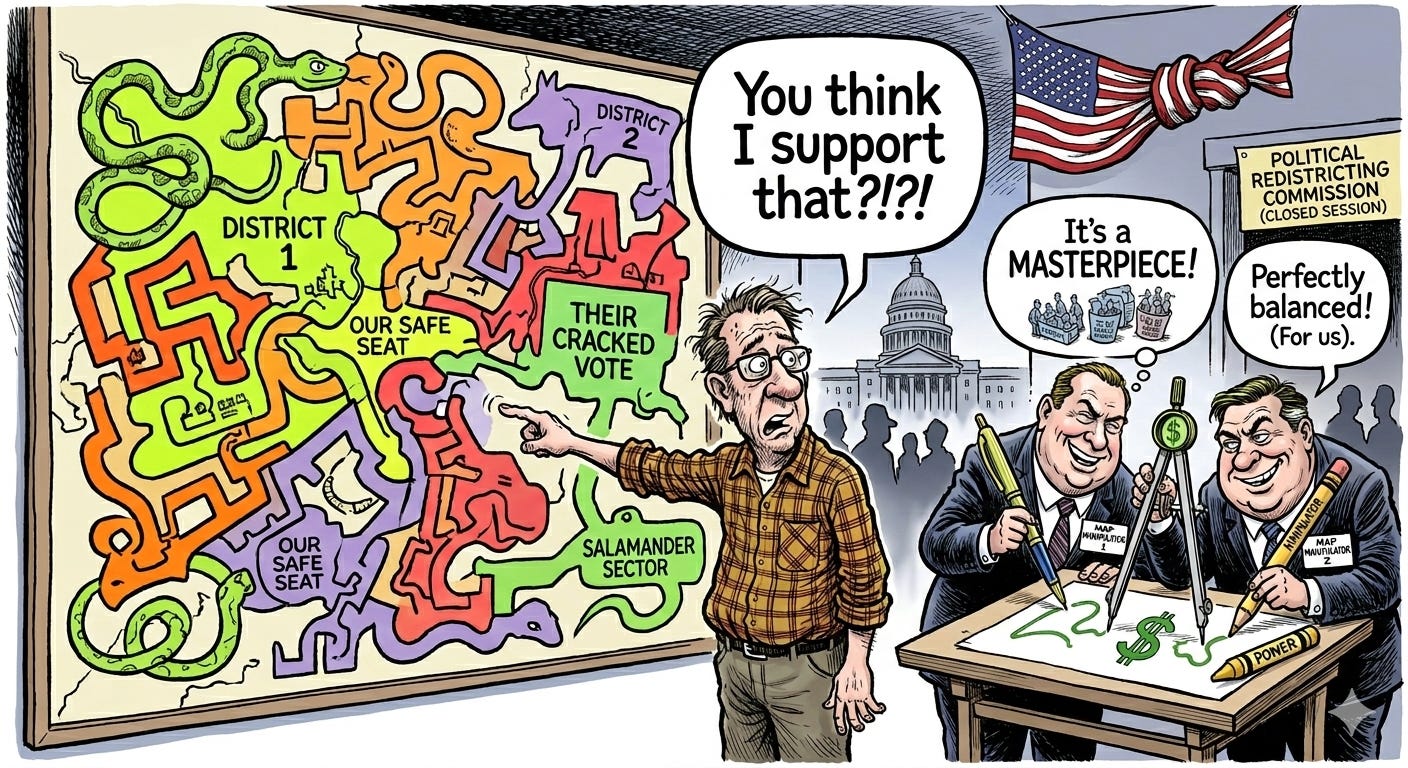
Does this poll result show a sea change in public opinion about gerrymandering or is there something else going on? We at Second Raven suspected that there were some problems with the questions Politico asked.
Here is the set of questions on which they based their conclusions (with the items in brackets changing based on the partisanship of the respondent):
[Republicans/Democrats] have proposed redrawing congressional districts in [red/blue] states to gain them more seats in the U.S. House of Representatives, to match and neutralize [Democrats/Republicans] doing the same in [blue/red] states. Would you support or oppose this?
Now. imagine the [Republicans/Democrats] propose redrawing congressional districts in [red/blue] states to not only offset [Democratic/Republican] gerrymandering, but gain an advantage in the midterms over them. Would you support or oppose this?
Just looking at this, and knowing the context of the questions from the headline above, you might not see anything wrong. The designers are trying to use both questions to draw a distinction between gerrymandering as only justified to level the playing field when the other side also cheats versus it being a political strategy to gain an asymmetrical advantage.
But this relies on the assumption that respondents will pick up on all of this context and unstated meaning. The word “now” is doing a lot of work here. That one word is supposed to signal to respondents that the second question excludes the motivations laid out in the first question. This is not an unusual conversational tactic, but it is not one that translates well into fixed text. Try it… If you were to do this in conversation, you’d naturally put extra stress on the word “now” and likely change your facial expression (we found we tended to nod our heads when saying it). You’d probably even move your hands in a way to signal the transition. Even then, the other person in the conversation needs to be paying attention to the transition. It is not clear that any of this crosses over into a fixed-form, text-based survey where respondents are likely paying less-than-full attention.
Moreover, the second question requires counterfactual speculation. Respondents have to remove themselves from their reality, where partisan gerrymandering is primarily pitched as a response to the same actions by the other side. It is not clear how well respondents can engage in such counterfactual reasoning without additional prompting.
Generally speaking, when fixed-form text surveys rely on more subtle conversational techniques like these, we should probably be suspicious of unusual survey results.
Even within this same poll, there are indications of problems. Among the same respondents, 78% of Trump voters and 81% of Harris voters support some step to make partisan redistricting by state legislatures more difficult, either through an independent process or by requiring popular approval. It seems strange that so many partisans both like gerrymandering and support policies to make it more difficult.
Second Raven’s Analysis:
We conducted our own audit of these questions with almost 600 respondents from CloudResearch, who identify as Republicans or Democrats. In addition to asking the exact same questions as the Politico Poll, we also used an AI interviewer to ask follow-up questions about why they supported or opposed gerrymandering for political gain. We then used AI to classify the reasons given for their responses.
When we asked the two questions from the Politico survey in their original order, we found somewhat less support amongst Republicans (41.2%) and somewhat more support amongst Democrats (55.8%). There are a number of reasons why that might be the case. For example, we used self-identified partisanship to define party affiliation, while Politico alternated between future vote intention and past presidential vote (we’re not sure why they did this or why they changed their method of identifying partisanship in reporting the results of different questions). But none of this is the important part of our findings.
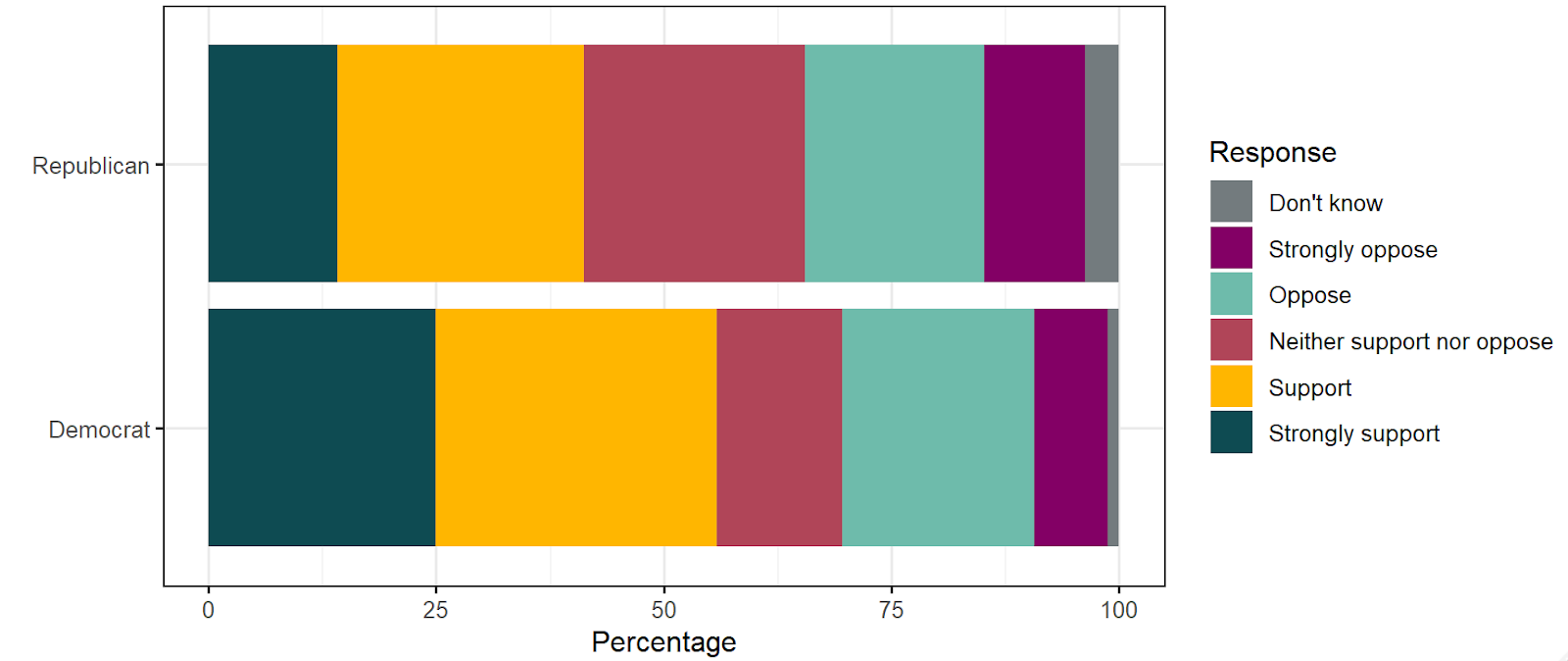
When those who said they “support” or “strongly support” gerrymandering for partisan advantage were asked why they supported it, the overwhelmingly most common response was that it was a tit-for-tat response to actions by the other party. 62.6% of Democrats and 59.8% of Republicans who said they supported partisan redistricting to get an advantage in the midterm election said they supported it as a response to partisan redistricting by their political opponents in the follow-up questions.
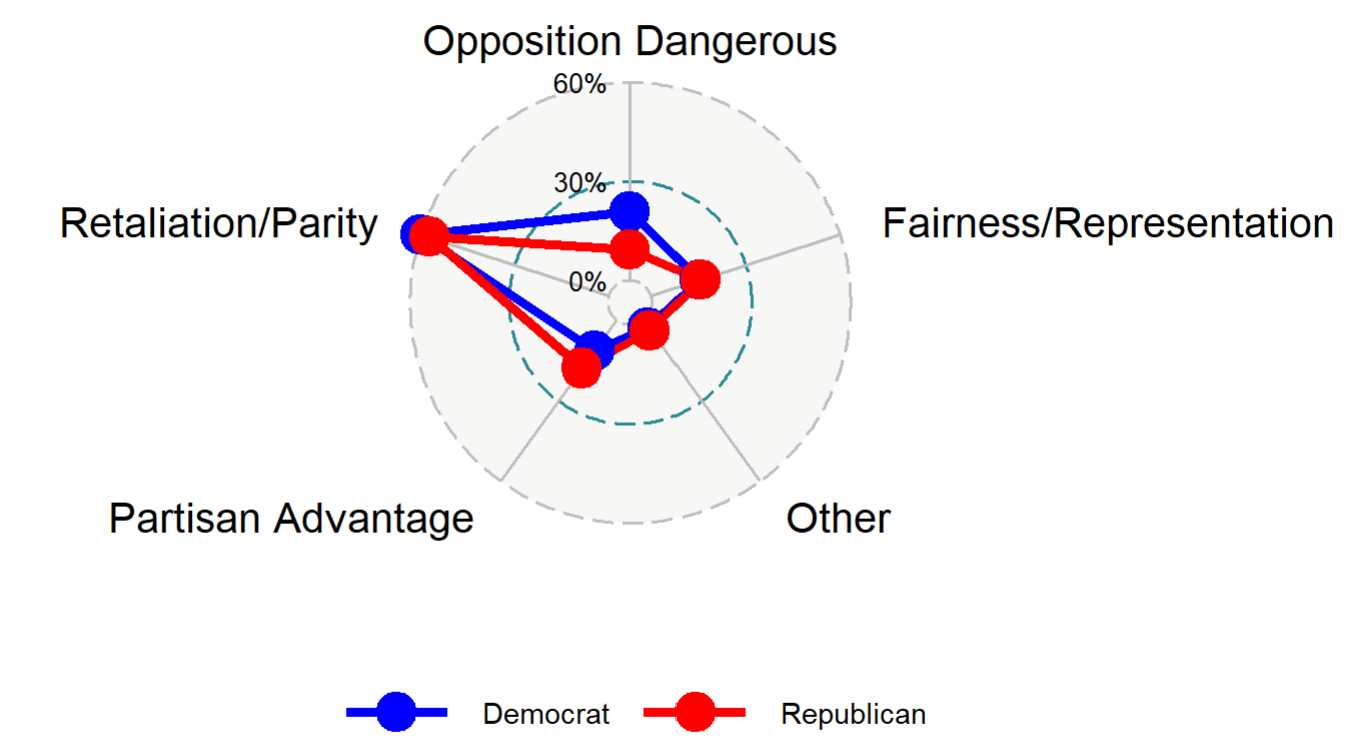
Once we take this into account, support for partisan gerrymandering for any reason other than as a response to the actions of the other party drops to 29% for Democrats and 20% for Republicans. It drops even lower if we take into account other fairness concerns or the people who were not clear on the meaning of key terms in the question like “gerrymandering” (usually labeled “other” in the chart).
Conclusions:
Because Politico’s poll relied on subtle conversation tactics and counterfactual thinking, it ended up producing a DRAMATICALLY MISLEADING estimate of support for gerrymandering. Most respondents who expressed support for gerrymandering did not catch the distinction.
There has NOT been a large change in support for gerrymandering amongst partisans in the U.S. Partisan redistricting remains an overwhelmingly unpopular policy.